

August 2026 - Tip of the Month - Not Just "Confused"
Recognizing Acute Altered Level of Awareness in Older Adults
When evaluating an altered LOA, the geriatric population throws out the standard rulebook.
Older adults may present atypically because reduced physiologic reserve, blunted compensatory responses, comorbid illness, and polypharmacy can mask expected findings. A subtle change in attention, behaviour, or level of awareness may be the earliest sign of infection, shock, occult trauma, stroke, medication toxicity, or metabolic illness. The most important first step is to establish whether the patient has acutely changed from their usual baseline.
By the end of this tip, paramedics will be able to identify an acute change from baseline, recognize high-risk atypical patterns, and complete a focused assessment for reversible causes of altered LOA in an older adult.
The “normal vitals” trap
You respond to an 84-year-old woman described by staff as “a little more confused and sleepy today.” She is normally conversational and ambulates with a walker. No fall has been reported. HR 78, BP 108/66, RR 22, SpO₂ 94% on room air, temperature 36.1°C, and BGL 7.0 mmol/L. During your assessment, she is inattentive and repeatedly drifts off.
Do the apparently acceptable vital signs reassure you, or increase the importance of identifying what has changed from baseline?
Establish baseline and recognize a delirium pattern
Do not rely on orientation questions alone. Determine whether the patient has changed from baseline and assess attention, thinking, and level of consciousness.
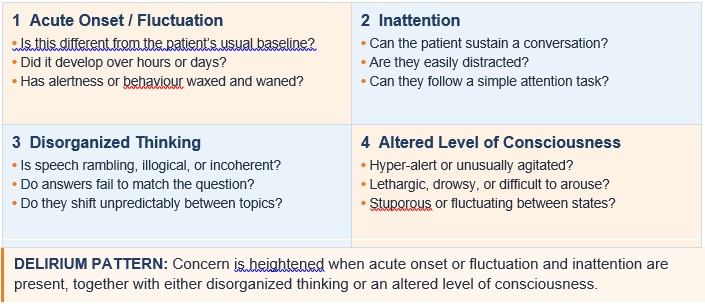
Looking beyond “Confusion” - Four clinical patterns that should raise concern
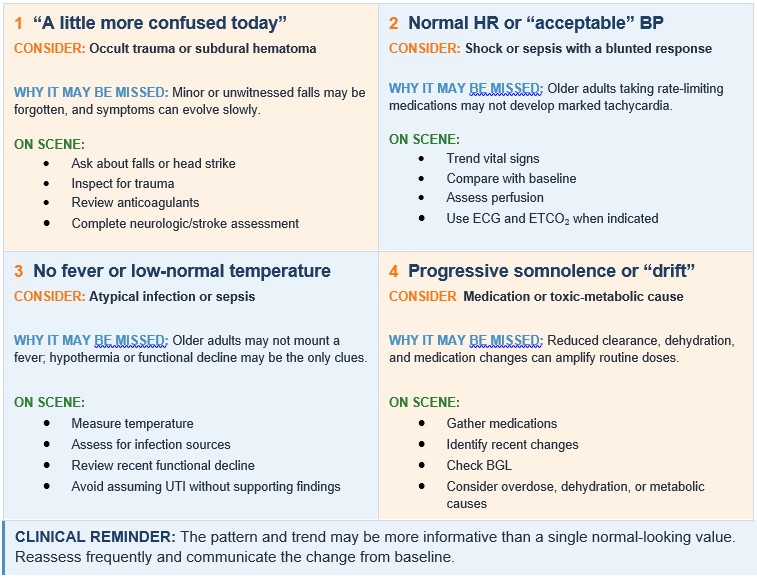
High-yield Assessment – Use a broad, structured assessment to identify reversible causes
- Collateral History & Baseline – ask family, caregivers or staff what has changed, when it began and what the patient can normally do.
- Focused Neurologic/Stroke Assessment – Look for subtle or fluctuating deficits.
- Head to Toe – Look for unwitnessed falls, head injuries, pain, dehydration, urinary retention, etc.
- Infection & System Review – Assess for respiratory, urinary, skin or wound, abdominal, and device-related sources of infection rather than relying on temperature alone.
- Cardiorespiratory Assessment – Respiratory effort, SpO2, perfusion and rhythm. Consider 12 lead ecg and ETCO2 (if available).
- Medication Review – Identify recent starts, stops, dose changes, duplicates, missed doses and high-risk medications.
Bottom Line: In older adults, acute confusion is not a normal consequence of aging. Identify the change from baseline, search for a reversible high-acuity cause, and reassess frequently – even when the first set of vitals appear normal.
Apply it on your next call: With your next older adults with altered LOA, can you clearly state: what has changed? When did it change? Has it fluctuated? Which high-risk causes did I actively assess?