
September 2026 - Tip of the Month - Safe Transfer of Care: Delivering a Clear, Concise Patient Handover
Transfer of care, or, patient handover, is a critical component of the emergency care process. This begins with the initial notification to the receiving facility, continues through potential offload delays, and is completed with a report to the receiving clinician who will be assuming responsibility for the patient’s ongoing care. A well-organized handover is essential for maintaining continuity of care, preventing communication gaps, and promoting patient safety. Handover report frequently occurs during high-stress medical emergencies, where competing priorities and environmental distractions can make it easy to miss pertinent patient information. Regardless of the receiving clinician or setting, it is important to ensure priority information and concerns are clearly communicated.
By the end of this tip, paramedics will be able to deliver a structured patient handover using the ISBAR framework to communicate critical information clearly and support safe continuity of care.
You arrive at the emergency department with a patient involved in a high-speed MVC. The trauma team is preparing equipment and your patient is being moved to the hospital stretcher. You begin giving your report and realize that your notes are out of order and you’re having difficulty organizing your thoughts from memory, all while the clinicians are asking you multiple questions. You walk away wondering whether everything important was communicated.
Does this sound familiar? A structured handover can help keep your report organized, even in the middle of the chaos.
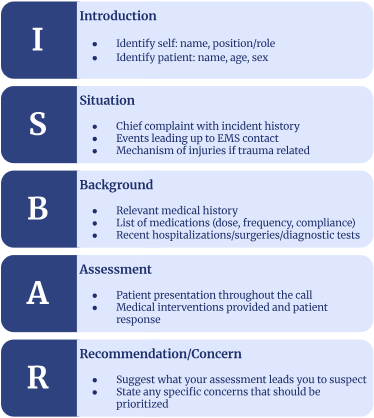
ISBAR: A widely recommended standardized framework for care transitions is the ISBAR tool (Identification, Situation, Background, Assessment, Recommendation/Concern). This is also a guideline for facilitating online medical consultations (OMC). The use of this tool promotes interdisciplinary teamwork among healthcare professionals, also favoring patient safety and comfort. It allows the paramedic to provide the important patient information in an organized manner that prevents ‘storytelling’ or unnecessary information (see image below).
Communicate Trends: Receiving clinicians often need to know what changed during transport, rather than just the last blood pressure or heart rate. Include in your report:
- Significant changes in vital signs
- Patient response to paramedic interventions
- Changes in patient condition (e.g., mental status, work of breathing, pain)
Closed-Loop Communication: A good handover is a two-way conversation. Pause briefly after your report to allow questions, clarify uncertainties, and confirm that critical information was received. If you're interrupted during handover, return to the ISBAR structure rather than restarting the story.
Commonly Missed Information:
- Trends in vital signs
- Medications administered en route (e.g., TXA infusion dose)
- Allergies and pertinent history
- Time-sensitive events
- Last known well
- Time of injury
- Symptom onset
- Time of ROSC
- Real-time updates regarding changes in patient condition during offload delay
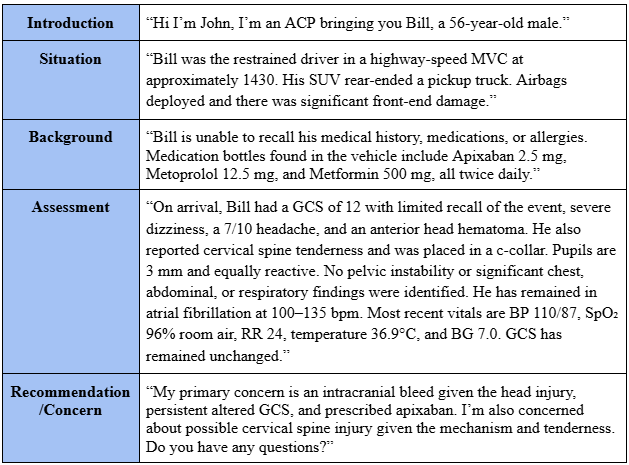
Using ISBAR, a strong handover report for the high-speed MCV may look like this:
Remember that handover is about transferring responsibility, not just information. A structured handover improves patient safety by ensuring critical information is communicated clearly, consistently, and without unnecessary delays.
The next time you are providing a handover report to a receiving clinician, recall the ISBAR framework in order to organize patient information and ensure a safe and organized transfer of care.