

October 2026 - Tip of the Month - End-Tidal Capnography: Beyond the Value
Capnography provides continuous, non-invasive information about ventilation by measuring exhaled carbon dioxide (CO₂). While the ETCO₂ number is useful, the waveform and trends can provide additional information about ventilation, airway patency, perfusion, and changes in a patient’s clinical condition. Understanding what the waveform is showing can help paramedics recognize problems earlier, confirm interventions, and identify deterioration before changes in other vital signs become obvious.
This tip will help paramedics to interpret ETCO₂ values and capnography waveforms in the context of the patient's overall clinical presentation and recognize clinically significant changes in ventilation and perfusion.
You arrive at a patient with an altered level of consciousness. They are breathing spontaneously with an SpO₂ of 98% and an ETCO₂ of 52 mmHg. You note that the waveform is becoming progressively smaller and irregular.
Is the ETCO₂ number the most important piece of information, or is the changing waveform telling you something more?
Look at the waveform, not just the number
- A normal capnogram has a recognizable rectangular waveform with a relatively consistent alveolar plateau.
- Changes in the shape, height, and consistency of the waveform can provide important clinical information.
- A “shark-fin” appearance can be associated with bronchospasm or obstructive lung disease.
- An absent, intermittent, or suddenly altered waveform may indicate apnea, airway obstruction, disconnection, displacement of an airway device, or sampling problems.
Trends are often more useful than a single ETCO₂
- ETCO₂ should be interpreted alongside respiratory rate, work of breathing, mental status, SpO₂, and other clinical findings.
- A rising ETCO₂ may indicate hypoventilation, while a falling ETCO₂ may occur with improving ventilation, or may signal decreased pulmonary perfusion or cardiac output.
- In a deteriorating patient, a significant change from their previous waveform or ETCO₂ should prompt reassessment and inform intervention rather than simply recording the new number.
Use capnography to assess your interventions
- After an airway or ventilation intervention, capnography can help determine whether the intervention is producing the intended effect.
- During CPR, ETCO₂ can provide information about the effectiveness of chest compressions and changes in circulation. A sudden sustained increase in ETCO₂ may be associated with return of spontaneous circulation, but should always be interpreted with the clinical picture.
- In patients receiving assisted ventilation, continuous waveform capnography can help identify changes in ventilation before they become clinically obvious.
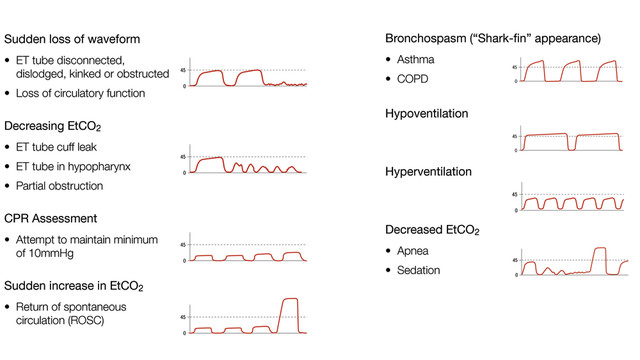
Don't focus solely on the ETCO₂ value. Assess the waveform, monitor the trend, and interpret both within the context of the patient's overall clinical presentation.
On your next call using capnography, ask yourself: “What is the waveform telling me that the number alone cannot"